
When Talent Isn’t Enough for Success
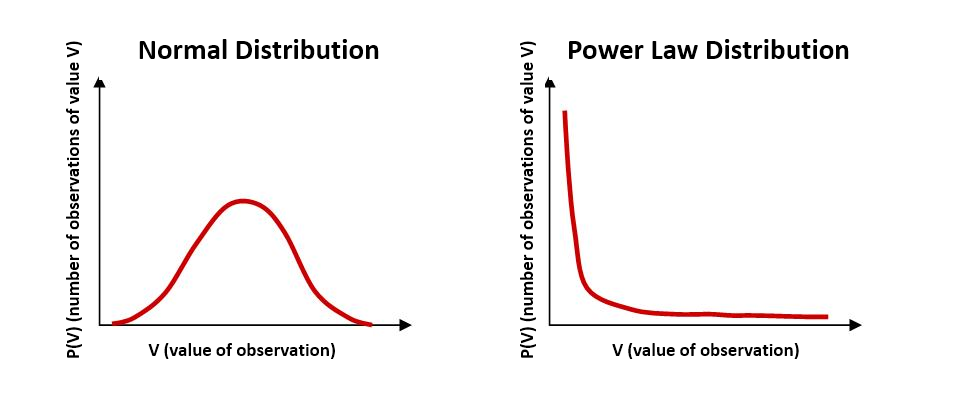
In a normal distribution, most things are average. In a power law distribution, a few things are huge, and most are tiny.
Most people assume success comes from a combination of hard work, talent, and time. In many careers, that is more or less true. Put in the hours, do good work, improve over time, and you will probably make progress. You may not reach the very top, but you can build a stable, respectable career.
Not every field works that way.
In some careers, you can be smart, driven, and genuinely talented and still struggle for years. The problem may not be your ability or effort. It may be the way success is distributed in that field.
Consider law, medicine, consulting, software engineering, and many other conventional careers. These tend to have outcomes that resemble a bell curve. Most people fall somewhere around the middle, while fewer reach the extremes. A good doctor and an exceptional doctor may earn different salaries, but the difference is unlikely to be enormous. There are limits to how much one person can earn or produce, and many people can build successful careers at the same time.
Now consider acting, music, sports, writing, and startups. These fields often have outcomes closer to a power law distribution. A small number of people capture a disproportionate share of the rewards. A few become extraordinarily successful, some make a reasonable living, and many others struggle to earn enough, including people who are highly skilled.
This is not primarily a question of fairness. It is a reflection of how these markets work.
In many conventional careers, income and output are constrained by time. A lawyer can meet only so many clients. A surgeon can perform only so many operations. An engineer can work only so many hours. Experience and skill can increase the value of that work, but the work itself does not scale indefinitely.
In other fields, a single piece of work can reach an enormous audience without requiring a comparable increase in effort. One song can be streamed billions of times. One app can reach millions of users. One book can outsell thousands of others. Digital distribution makes it possible to reproduce and distribute a product at very low marginal cost, while the potential audience can be enormous.
When this scalability combines with limited attention, rewards become concentrated. People listen to a relatively small number of artists, buy products they have heard about, and pay attention to a handful of startups that attract investors. Many alternatives may be good, but being good does not guarantee that people will discover them or choose them.
In these fields, talent is necessary for many forms of success, but it is rarely sufficient on its own. Distribution, timing, networks, visibility, and luck also matter. The ability to create something valuable is different from the ability to get it noticed, adopted, or rewarded.
We often confuse these two kinds of careers. We assume that the same relationship between effort and outcome applies everywhere. If we become good enough, we expect the rewards to follow. When we see a successful actor or founder, we study what they did and assume that following the same steps might produce a similar result.
But the outcomes in power law markets are highly uneven. Two people with comparable abilities can have very different careers because one reaches the right audience at the right time while the other does not. Early success can attract more attention, resources, and opportunities, making it easier to pull further ahead. The eventual gap between them may have little to do with the gap in their original abilities.
These markets are not pure meritocracies. Skill matters, sometimes enormously, but it does not determine the outcome by itself.
Misunderstanding this can be costly. People enter these fields without appreciating how few participants capture most of the rewards. They compare themselves with the most successful people in the industry, treating exceptional outcomes as if they were ordinary results of hard work. When their own careers do not follow the same path, they may conclude that they lack talent or have failed to work hard enough.
Neither conclusion necessarily follows. They may be working in a field where good work often goes unnoticed and where success depends on factors they cannot fully control.
None of this means you should avoid these careers. Some of the most valuable and interesting work happens in fields with highly unequal outcomes. But it helps to understand the risks before committing years of effort. You need to distinguish between what improves your chances and what you can reasonably expect those efforts to deliver.
The distinction also affects how you approach the work. In a conventional career, steadily improving your skills and performance may be enough to make consistent progress. In a power law market, you may also need to find an audience, build relationships, choose the right opportunities, and keep working through long periods without much external recognition. Even then, success is not guaranteed.
In careers with more conventional distributions, progress tends to be more gradual. In power law fields, it can be difficult to distinguish a promising trajectory from years of effort that will never produce a comparable return. A breakthrough may come suddenly, but there is no guarantee that it will come at all.
The important thing is to understand the kind of market you are entering and make decisions with its risks in mind.